
Inside Shoshone Property Tax Records
Match the file to the question. Shoshone County property tax records can show the value used for taxing, any relief applied, the installments billed, payments made, or amounts past due. They cannot replace a deed or an appraisal.
| Tax record | Parcel fact supplied | County source |
|---|---|---|
| Assessment notice | Current-year market value and appeal deadline | Assessor |
| Assessment record | Owner, parcel, land and improvement detail when maintained | Assessor |
| Tax bill | Tax year, installments, districts, levy, and amount due | Treasurer |
| Payment ledger | Receipts, postmarks, late charge, interest, and prior years | Treasurer |
| BOE file | Owner claim, county value, evidence, hearing, and decision | Board of Equalization |
| Tax-deed file | Delinquency, notice, redemption, auction, deed, and proceeds stages | Treasurer and Recorder |
Request the bill and the payment ledger as separate items. The county's payment link serves payments, not a full public tax-history search. For reliable results, ask the Treasurer directly by parcel number and tax year.
Shoshone County’s January Assessment
The Shoshone County Assessor values nonexempt property at market value. Assessments are dated January 1. They rest mainly on sales from the prior year, though sparse sales may push the office toward other periods or comparable areas. Assessment notices go out in early June.
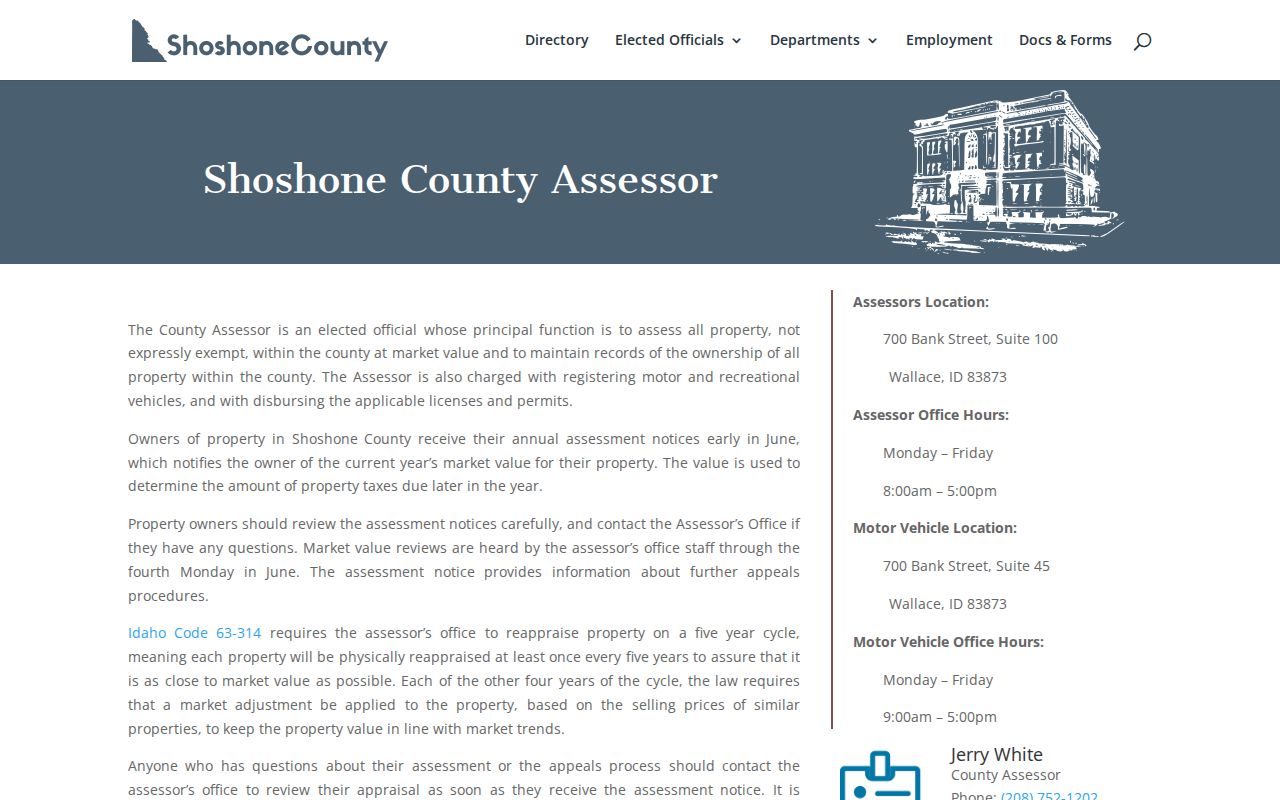
The Assessor's page anchors the county value record. It summarizes Idaho Code 63-314, which requires a physical reappraisal at least once every five years, with market adjustments filling the gaps. That schedule does not put an inspector on every parcel each year.
Retrieve a Shoshone Tax Account
Pull a parcel code from the county GIS first. Then contact the Treasurer for the exact tax year, bill, and payment history. Going straight to the office avoids mistaking the payment processor for a complete research database.
- Search the address in GIS and preserve the parcel number exactly.
- Request the tax bill for a named year from the Treasurer.
- Ask separately for the payment ledger, receipt, payoff, or delinquent years.
- Compare the assessed and taxable values with the Assessor’s dated record.
- Keep tax-deed, redemption, and auction documents as distinct files.
- Assessed value
- The value carried in the assessment process.
- Taxable value
- The value left for tax calculation after applicable relief.
- Levy
- The rate applied for taxing districts and budgets.
- Tax lien
- The government claim arising from unpaid property tax.
Shoshone Property Tax Due Dates
The Treasurer splits real-property taxes into two equal halves. The first half comes due December 20. The second is due June 20. Paying between December 21 and 31 triggers a 2% late charge, and from January 1 the delinquent tax plus that charge accrues 1% interest each month. Partial payments are allowed monthly, though the taxpayer should call for current payoff figures and pay enough to prevent delinquency. Delinquent funds apply to the oldest year first. Under the Idaho Code 63-217 rule the county cites, the postmark counts as the filing date. A bill that never arrives does not excuse the added charges.
Pay Shoshone County Property Tax
The Shoshone County Treasurer sits at 700 Bank Street, Suite 110, Wallace, reachable at (208) 752-1261 and keddy@co.shoshone.id.us. Point & Pay handles online payments. The county posts a 2.45% card convenience fee with a $3 minimum, $3.95 for Visa debit, $2 for e-check, and $20 for insufficient funds.
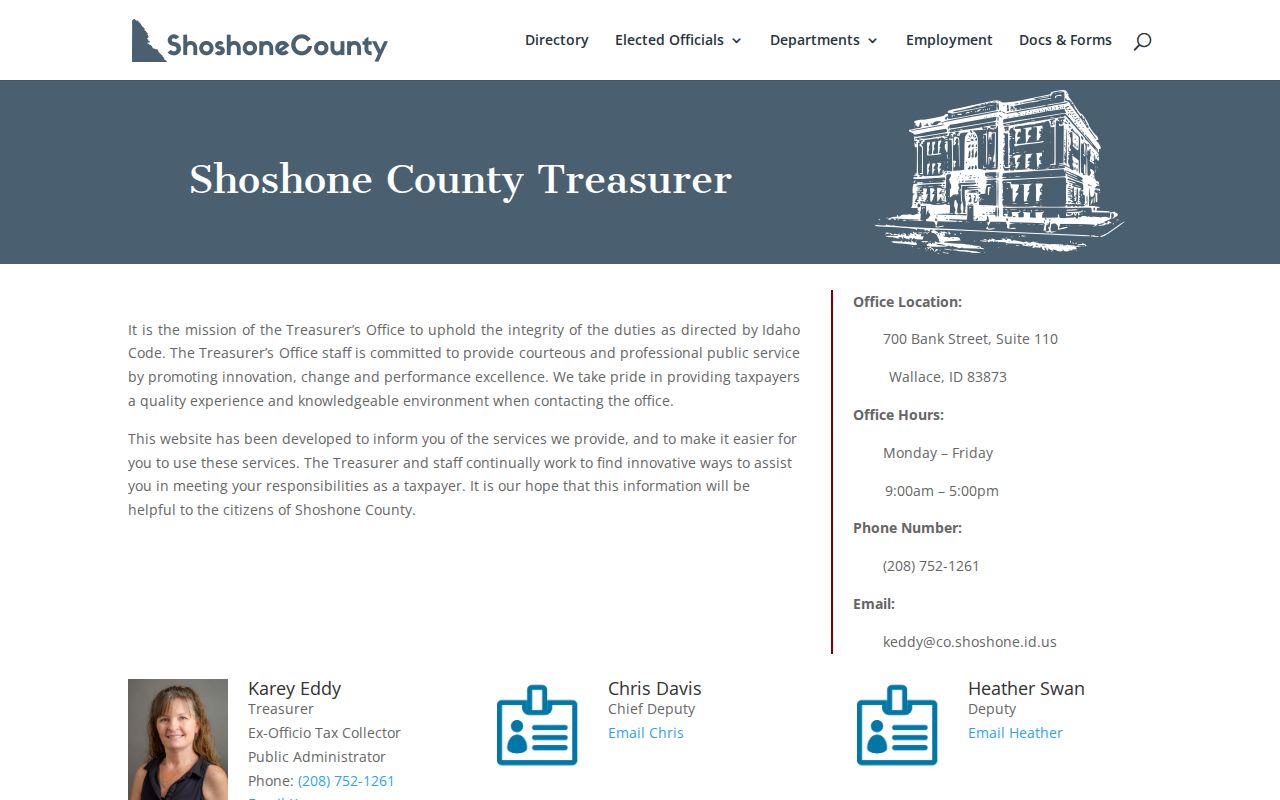
The Treasurer's official page carries the current payment instructions. Verify all charges before paying, since processor terms can change. Keep the receipt with the tax year and parcel code noted.
Shoshone Assessment Relief Records
Idaho relief programs adjust taxable value, not ownership. The state offers a homeowners exemption covering a primary residence and up to one acre. Its timing generally runs January 1 through April 15. Agricultural, forest-land, disabled-veteran, and other forms may generate their own assessment records. When you research an exemption, ask the Assessor for the application. Ask also for its status, the assessment year, and the public value fields it produced. A relief entry is never deed proof. Shoshone County's landscape holds extensive forest uplands. Forest-land classification therefore matters often in rural tax research here.
Contest a Shoshone County Value
The Assessor reviews market value claims through the fourth Monday in June. The notice itself carries the operative appeal date. The Board of Equalization handles valuation only. It cannot settle title or repair a deed chain. The 2025 packet required one form per parcel. It needed an original plus four copies, filed by 5 p.m. on the fourth Monday in June. It requested the assessor's land, building, and total values, plus the owner's estimate and a factual or legal basis. Helpful support included prior-year comparable sales and closing statements. Appraisals, photos, and facts unique to the property also helped. Packet rules must be rechecked every year.
Appeal window. Act when the early-June notice arrives. The printed deadline and current Board packet control, and the issue must be value rather than ownership.
The Board of Equalization page posts the live packet, filing terms, hearing details, and any further state appeal route.
Request Shoshone Tax History
The county's public-record request form can route a precise tax inquiry to the Treasurer, Assessor, Clerk, or the Board of County Commissioners. The Board of County Commissioners can also receive it. Name the parcel number, situs, legal description, tax or assessment year, and the document wanted. Add the date range. You may ask for delivery by email, mail, pickup, or in-person review. For a payment question, treat the bill, ledger, receipt, and payoff as separate items. An appeal request should cover the notice, filed form, attachments, hearing record, and decision. It should also include any later state appeal. For delinquency, name each stage you need. The form also asks about resident status and follow-up preference. It asks whether the request is a mailing or telephone list. A focused parcel request should stay that way rather than becoming a bulk list.
Separate Shoshone Tax-Deed Stages
Delinquency does not make an auction result inevitable. Shoshone County describes redemption for up to 14 months after tax-deed issuance or until auction under Idaho Code 63-1007. The annual live sale uses posted lists and newspaper notice. Eligible parties may redeem before sale.
A tax-deed packet can identify the parcel, assessed owner, situs or “no known address,” legal description, taxes and costs, and parties in interest. Later events may include redemption, an auction bid, a Commissioner’s Deed, recording, or excess proceeds. Keep the timeline intact. An advertised parcel is not necessarily sold, and a sold parcel is not necessarily insurable.
The county’s 2022 and 2023 packets show why both parcel code and legal description matter. Examples include a Wallace townsite lot, a Mullan tract stated by section and range, an Osburn parcel, and a redeemed Pinehurst patented mining claim. Address-only tax research would miss part of that landscape.
Read Shoshone Levy Components
A tax bill in Shoshone County reflects taxable value plus district levies. It is not a direct measure of what a property would sell for. Ask the Treasurer for a bill that breaks out each levy component, then set it beside the Assessor's taxable value for the same year before drawing any conclusion. A change in the amount can stem from value, relief, budgets, or levies, so preserve each part of the tax roll before explaining the cause.