
Compare Shoshone County Value Types
Shoshone County property value records pull from several related terms, and the labels are not interchangeable. Before comparing any two figures, check the year, the value type, and which office recorded it.
| Value type | Meaning | Record source |
|---|---|---|
| Assessor market value | County estimate for the January 1 assessment | Assessment notice or Assessor record |
| Taxable value | Value used after applicable relief | Assessment and tax records |
| Sale consideration | Amount stated in a transfer, when disclosed in the instrument | Recorded deed image |
| Land and improvements | Components that may support the total | Dated property record, if maintained |
A sale price records what one buyer paid. An assessed value comes from the county's tax system instead. Taxable value may sit lower still, because exemptions and relief shrink the tax base without touching the market estimate or the title shown in Shoshone County deed records.
Retrieve a Shoshone Property Value
Start with the county's public GIS map to locate the parcel. The county offers no separate public text property-card portal with a complete value history, so the map may not surface every value field you need. When it falls short, ask the Assessor for a dated record tied to the parcel number.
- Search the address in county GIS and copy the exact parcel ID.
- Request the Assessor record for a stated assessment year and date.
- Separate market, taxable, land, improvement, and exemption fields actually supplied.
- Request the recorded deed image if sale consideration is needed.
- Record the source and date beside every number.
- Assessed value
- The value carried through the public assessment process.
- Market value
- The Assessor’s estimate under Idaho’s full-market-value standard.
- Assessment ratio
- A comparison of assessed values with sale prices across a group.
- Reassessment
- A later valuation cycle or update, not necessarily a sale.
Shoshone County’s January Value
The Shoshone County Assessor appraises nonexempt property at market value. The valuation date is January 1. Sales from the prior year drive most of the math. Local sales can run thin. The assessor then draws on other periods or comparable areas instead.
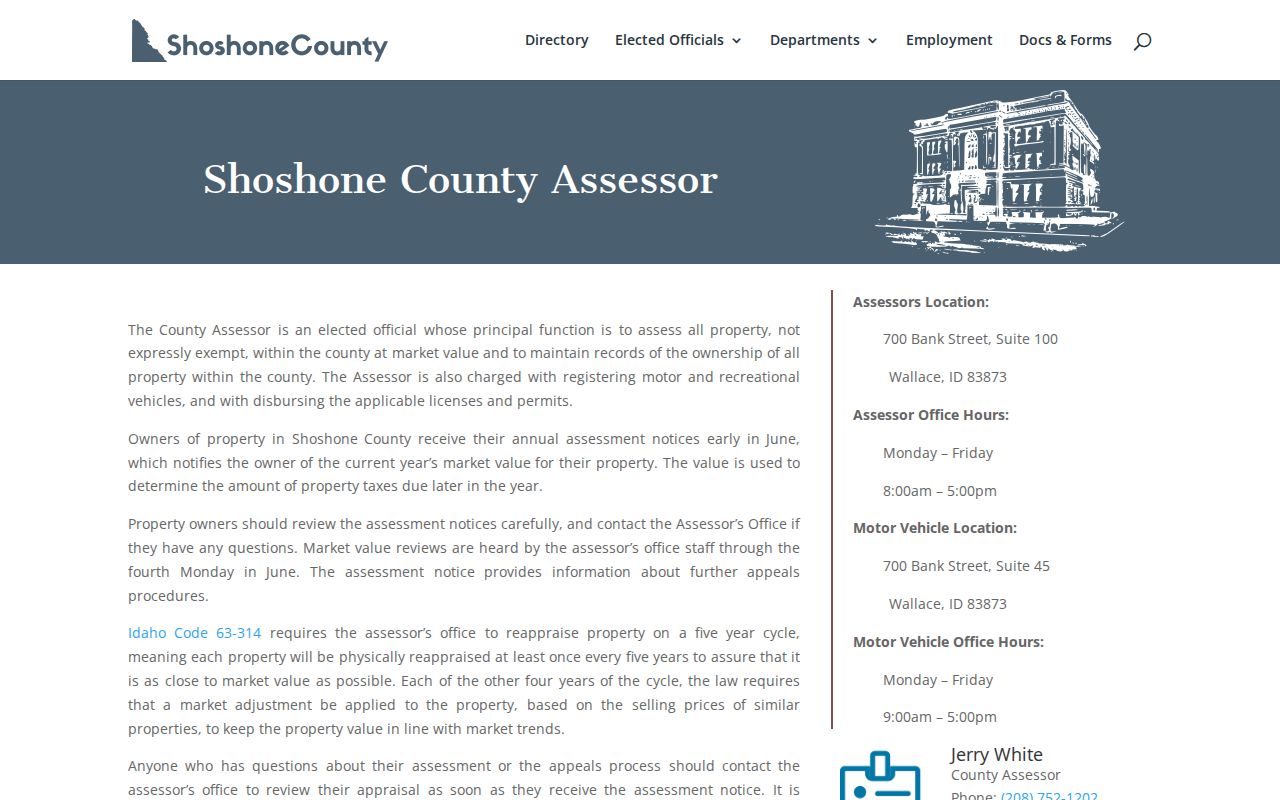
The official Assessor page names the value custodian and spells out the assessment method it applies. Early-June notices show the current year's market value and start the short review and appeal period.
Shoshone Property Reappraisal Timing
Idaho Code 63-314 sets the schedule. It requires a physical reappraisal of each property at least once every five years. In the years between, Shoshone County can adjust values through sales of similar parcels. So a shift in your assessed value does not prove anyone inspected the property. It also does not prove they built an improvement or recorded a transfer. The number alone tells you little about why it moved. Check the assessment year, the valuation date, and any notes on the record. A physical detail may look wrong. Ask the Assessor what data backed that year's entry instead of guessing from the change itself.
Read Idaho Ratios Carefully
The Idaho State Tax Commission ratio-study program weighs assessed values against actual sale prices. That gauges how well assessments perform. The target is market value. That goal sits near 100 percent in the study's own explanation. A statewide median is not a Shoshone County ratio. Nor is a row for some other county. Use only a separately confirmed Shoshone County figure for any claim about the county. Keep the study year attached. Remember what a ratio study measures. It judges a group of parcels, not one property's appraisal or your parcel number.
Find Shoshone Sale Consideration
For consideration or transfer language, the recorded deed image is the document to pull. Shoshone County publishes no last-sale-price field on its parcel cards. So do not invent a figure. A tax-deed minimum bid is not the property's market sale price either. Deed records and land records run from 1871 forward at the Clerk/Recorder. Request the instrument by current and prior party names. You can also use a parcel number, legal description, or date range. Some transfers, such as gifts, quitclaims, estate distributions, and Commissioner's Deeds, are not arm's-length sales. Treat their stated amounts with care.
Separate Shoshone Value Components
A parcel record can break value into parts. Land sits in one line, and improvements sit in another. Exemptions fall in a third, then a taxable total. Not every Assessor component shows up online. Ask for the dated property card instead of assuming GIS displays the whole record. Exemptions matter here too. They lower taxable value. But they prove nothing about who holds title, and the reduced figure is not market value. Building permit valuation is its own animal. It measures a proposed project for permit review, not the parcel's open-market worth on the tax roll.
Test a Shoshone Assessed Value
The Board of Equalization packet reveals what evidence actually moves an assessed value. Its parcel-specific form requests the Assessor's land, building, and total figures. It also seeks the owner's own estimate and a factual or legal basis for the claim. The 2025 edition cited 2024 comparable sales, closing statements, an appraisal, and photographs. It also cited facts unique to the parcel.
Those categories tell a story. One lone sale cannot carry an appeal. A statewide average cannot either. Comparable properties must fit the valuation date and the local market. A photograph or a condition detail can help. It can justify why a subject parcel breaks from its peers. Remember the limits, though. The Board weighs valuation only; it never settles ownership or rewrites a deed.
Deadlines and filing rules live on the assessment notice and the current packet. The 2025 packet demanded one original and four copies. It set a deadline of 5 p.m. on the fourth Monday in June. Recheck those details before any later appeal.
Value Silver Valley Land Carefully
Shoshone County parcels vary widely. City lots sit beside forest uplands and patented mining claims. A tax-deed packet may describe tracts by section, township, and range rather than by street. Because the patterns differ so much, a single countywide comparison can mislead. The county itself notes that forest uplands cover much of its land. It publishes forest-land assessment material for that class. Classification and exemptions can shift taxable value without pointing to any current sale price. Mining claim names, access rights, surface management, flood data, and water layers all help frame the right questions. Every right still has to be verified in its own source record. Save the full legal description next to the parcel number. Modern codes change or vanish in older deeds. But the townsite, addition, claim, or survey wording keeps the property records link intact across time.
Request a Shoshone Value Record
A thin GIS result calls for a direct request. Send the Assessor a focused ask for the property record as of a stated year and date, listing the parcel number, situs, owner of record, and legal description. Request only the value components you need: land, improvements, total market value, taxable value, exemptions, and assessment-year notes. The county public-record form lets you pick the department, date range, record description, and delivery method, whether email, mail, pickup, or in-person review. Precise terms matter. They prevent the office from sending a current record when the real question is an older value in the deed records or tax roll.
Distinguish Shoshone Taxable Value
The figure on a tax account is not always the Assessor's market-value estimate. Exemptions and classifications sit between the two numbers. That gap does not mean either record is wrong. It means each serves a different stage of the property-tax system. A levy works the same way. It changes the tax bill without touching the assessed market value of the land. Keep the value record with its assessment year attached. Pull the separate tax bill only when the calculation itself is the question. Never reverse-engineer a sale price from taxes paid.
Limit Shoshone Property Value Claims
A Shoshone County assessed value exists for the public assessment system. It is not an offer. It is not a guaranteed sale price, a boundary opinion, or a title conclusion. A buyer may bring in an independent licensed appraisal. That appraisal weighs the subject property against real market evidence. For tax bills, exemption administration, or an assessment appeal, follow the Shoshone County property tax records process. Keep those procedures apart from what the value number itself means.
Online estimates from unnamed private models are not county property records. They may rest on incomplete sale, size, or condition data. Treat them as outside opinions. Never relabel one as the Assessor's figure. Keep the official record date and valuation standard clear.
Value is not price. An assessed value supports taxation and is not what a Shoshone County property will necessarily sell for. It is not an appraisal.
Conditions arising after the valuation date may never reach that year's public number. A private improvement, an access issue, a mining feature, or a physical defect can demand evidence beyond the basic roll. Ask what date and characteristics the Assessor used. For a purchase decision, pair the dated public value with inspection, title, survey, and independent market work suited to the parcel. Tie every conclusion to the record or professional that produced it.
A Shoshone County property value entry needs six facts. These are the parcel number, value label, assessment year, January 1 valuation date, record date, and custodian. Without them, two valid numbers can look contradictory. Save the notice or dated Assessor response instead of copying an isolated figure. When comparing a deed, preserve the execution and recording dates. Note whether consideration was disclosed. A spreadsheet should never shrink the record to an unlabeled dollar amount. Keep the source request details and any stated exemption. Note whether the figure is market or taxable value.